
Ask three roofers what to put on a flat roof and you might get three different answers. Felt, single ply membranes, cold-applied liquids, hot melt and mastic asphalt all do the same basic job, but they’re laid differently and each suits some roofs better than others.
If you’re planning a flat roof replacement in Pontefract, Castleford or Featherstone, this guide walks through the main systems side by side, so you know what you’re being offered and why. If you’re earlier in the process and still deciding whether replacement is needed at all, our beginner’s guide to flat roof replacement is a good place to start.
Built-up felt and torch-on felt
Modern roofing felt is a long way from the thin sheets people remember on old sheds. The industry term is reinforced bitumen membrane: a strong polyester-based sheet coated in bitumen. According to the National Federation of Roofing Contractors (NFRC) householder’s guide to flat roofing (2015), it’s the most common system on homes, built up from two or three layers bonded together.
How it’s laid
There are a few ways of bonding the layers. With pour and roll, hot bitumen is poured in front of the roll as it’s unrolled, which glues the sheet down and seals the laps. Torch-on felt is heated with a gas torch so the bitumen on the sheet itself does the bonding. Cold-applied and self-adhesive versions avoid heat altogether.
Where it suits
Felt is a sound, well-understood choice for garages, single-storey extensions, dormers and porches, and it’s used on larger commercial roofs too. Because torching and hot bitumen involve heat, the contractor has to take fire precautions, and the NFRC notes that torching isn’t suitable over or next to flammable materials. On some roofs that means a cold-applied method is the better option.
Practical points
Felt roofs have laps and joints, so the quality of the detailing at edges, upstands and outlets matters a great deal. Most felts need a protective top surface such as a mineral finish or chippings. If you’ll be walking on the roof regularly, for example to reach a balcony, it needs a suitable walking surface rather than bare felt.
Single ply membranes
Single ply roofing uses one layer of tough polymer sheet, supplied in wide rolls.
How it’s laid
The NFRC describes three main ways of holding it down: mechanically fixed with fasteners through to the deck, bonded with adhesive, or held down by ballast such as paving. The sheets are joined along their edges, and the NFRC notes single ply works best as part of a warm roof, where the insulation sits above the deck.
Where it suits
Single ply is well suited to larger, simpler roof areas, which is why it’s so common on commercial buildings. Because the sheets are fixed or bonded rather than torched, it can also be a practical choice on occupied buildings where hot works are best avoided.
Practical points
With a single layer, the joints and the details around rooflights, pipes and upstands are where the care goes. It’s not designed for regular foot traffic without walkways or protection, so it’s worth thinking about how often the roof will be accessed.
Cold-applied liquid systems
Cold-applied liquid roofing, including the Sealoflex system we use, is applied as a liquid with a polyester reinforcing fleece bedded into the wet coat, then cures to form the waterproof layer. No heat is involved. The NFRC describes the result as a "completely seamless membrane". We’ve explained how these systems work in more detail in what is liquid flat roofing and how does it work?
Where it suits
That seamless finish makes liquid systems especially useful on roofs with lots of penetrations, such as soil pipes, vents, rooflight upstands and plant bases, where cutting and sealing sheet materials around every obstacle creates more joints. Liquids are also often used to overlay an existing roof in sound condition, and because they’re cold-applied there’s no need for torches, which helps on occupied homes and buildings.
Practical points
A liquid system is only as good as the surface beneath it, so preparation is everything. The deck needs to be sound and dry, and the existing covering clean and well bonded if it’s being overlaid.
Hot melt
Hot melt is a different thing from the cold-applied liquids above, even though it also goes on as a liquid. It’s a rubberised bitumen that is melted on site, poured hot onto the deck and spread in two layers with a reinforcing sheet between them, giving a seamless membrane fully bonded to the deck. It’s used mainly on concrete decks, typically on larger buildings, and is usually covered by insulation and ballast, paving or a green roof rather than left exposed. It isn’t a typical choice for a timber-decked garage or extension.
Mastic asphalt
Mastic asphalt is a traditional material, melted and laid hot by hand in layers.
Its main drawback is weight. The NFRC points out that because of its weight, asphalt needs a considerably stronger roof construction, which in practice usually means a concrete deck. That makes it unusual on timber-decked garages and extensions. Where an existing asphalt roof is in good overall order, repairs to the asphalt itself can often make more sense than switching systems.
A note on GRP
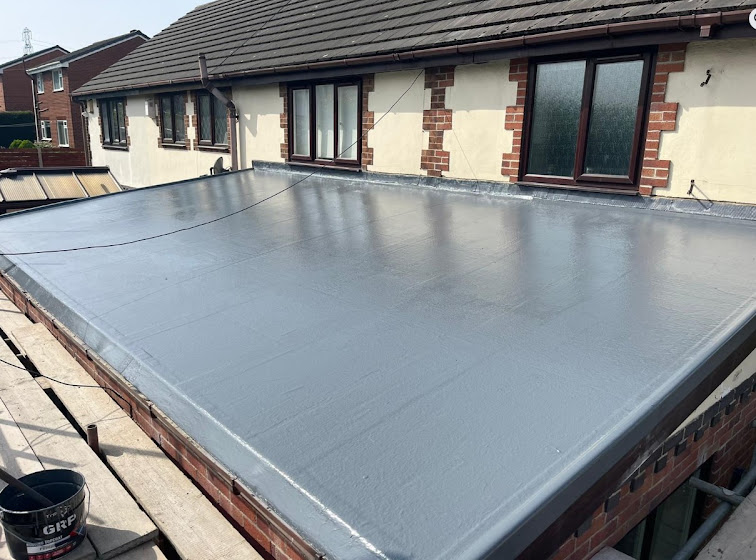
GRP (glass reinforced plastic, often called fibreglass) is also cold-applied, but it works differently from flexible liquid coatings. A polyester resin is laid with glassfibre matting and cures to a hard, rigid, seamless finish, with pre-formed trims at the edges. The NFRC says GRP systems must be laid on good quality plywood or OSB decking only, so it’s mostly seen on timber-decked roofs such as garages, extensions and dormers. The resin needs dry conditions to cure properly, so it can’t be laid in wet weather or when it’s freezing.
What a replacement involves beyond the waterproofing
A lasting flat roof depends on what’s underneath and around the covering. A proper replacement quote should cover these points.
The deck
Once the old covering is stripped, the deck is checked. Rotten or soft boards need replacing, and the NFRC advises against chipboard decks because of problems with moisture. Laying a new system over a failing deck is a false economy.
Insulation and Building Regulations
Replacing a flat roof is often the right time to improve its insulation, and sometimes it’s a requirement. Under regulation 23 of the Building Regulations, renovating or replacing more than 50% of a roof’s surface area generally means the whole roof should be brought up to current thermal standards (Part L), where that’s technically, functionally and economically feasible. The Planning Portal’s guidance on re-roofing says most re-roofing work will need Building Regulations approval, although some repairs to flat roofs won’t need an application. Extra insulation on top of the deck makes the roof thicker, which can affect upstands and door thresholds, so it needs planning from the start.
Falls and drainage
Flat roofs aren’t truly flat. They need a slight fall so rain runs to the gutter or outlet. If your old roof holds puddles, a new covering on its own won’t fix that. Falls can be corrected with tapered firrings under the deck or tapered insulation above it.
Upstands and edge trims
Most leaks start at the edges and junctions rather than in the middle of the roof. The NFRC recommends the waterproofing runs at least 150mm up adjoining walls, protected by a flashing at the top. New edge trims and properly formed details at gutters and outlets are a big part of a well-built roof.
Looking after your new roof
Whichever system you choose, a little regular attention goes a long way. The NFRC recommends inspecting a flat roof twice a year, in March and November, and checking that gutters and outlets are clear of debris. Our flat roof maintenance guide for winter has more practical tips.
Which system is right for your roof?
There’s no single best flat roof system. The right choice depends on the deck, the size and shape of the roof, how many pipes and rooflights come through it, whether it’ll be walked on, and whether hot works are practical. A good roofer should explain why they’re recommending one system over another for your roof specifically. You can read more about what we offer on our flat roofing and commercial flat roofing pages.
Talk to DPR Roofing about your flat roof
DPR Roofing is a family-run business that has been roofing across Yorkshire since 1989. If your flat roof is leaking, holding water or simply past its best, we’ll take a look, talk you through the options and give you a clear quote. Get in touch or call us on 01977 220016.